




This article contains spoilers for “Wicked: For Good.”
When it was announced that the long-anticipated film adaptation of the hit musical “Wicked” would be split into two parts, there were doubts that this was done for any reason other than to maximize profit. With the release of “Wicked: Part I” last November to rapturous praise, people’s hopes were high for “Wicked: For Good.” The second act of “Wicked” (the musical) is known to have problems—in fact, the original faced mixed reviews when it first appeared on Broadway—but the eager masses, including me, were hoping for the filmmakers to make the most of the extended runtime and rework this section of the story to be successful.
Unfortunately, it is now evident that “Wicked” has been bisected solely as a marketing ploy by Universal Pictures. In “Wicked: For Good,” director Jon M. Chu and his team fail to offer a compelling reason for the existence of two separate movies when “Wicked” could have successfully been adapted into one (long) movie. “Wicked: For Good” is an overly faithful reproduction of a source material that is known to have weaknesses. This film is a missed opportunity; if only the writers had the courage to modify the story.
“Wicked: For Good” picks up three to five years (seemingly; it’s never specified) after “Part One” ended. It opens with Elphaba (Cynthia Erivo)—now known to the citizens of Oz as the Wicked Witch—swooping in to rescue a few oxen from mistreatment by Ozian soldiers while they pave the famous yellow brick road. As was revealed in the first movie, the Wizard (an aimless Jeff Goldblum) has orchestrated a campaign to quash the autonomy of Oz’s talking animals. Elphaba advocates for their liberty, leading to her fugitive status and demonization by the Wizard.
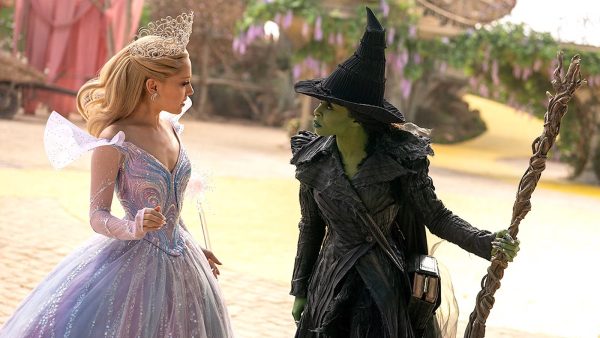
As Elphaba pursues various slightly terroristic acts to try to achieve her cause, her nemesis-turned-friend-turned-frenemy, Glinda (Ariana Grande), feels conflicted; as the new spokesperson for the Wizard’s regime, Glinda is torn between her popularity and her moral obligation to do what she knows is right. Formerly shallow Prince Fiyero (Jonathan Bailey), who is now engaged to Glinda, feels deeply troubled by his position as captain of the Gale Force, the squadron responsible for finding and killing the Wicked Witch, as his allegiance secretly lies with Elphaba.
Eventually, Elphaba causes a stampede in the Emerald City, disrupting Fiyero and Glinda’s wedding and nearly getting herself captured—but Fiyero, in a twist, reveals his love for Elphaba and helps her escape. A jilted Glinda helps lure Elphaba out of hiding, which ultimately results in the death of Nessarose (Marissa Bode), Elphaba’s sister, to Dorothy Gale’s falling house. Elphaba, distraught, arrives at the scene, where she finds Glinda. This should be a highly emotional confrontation; instead, it devolves into a comical slap fight between the two women, as Nessa’s dead body lies just feet away. This is a much darker story than “Part One,” but the filmmakers still tried to inject levity—in all the wrong places.
A house falling from the sky sounds familiar, doesn’t it? It turns out, Nessa is actually the Wicked Witch of the East (somehow), and her death is just one of many contrived connections “Wicked: For Good” attempts to make with the classic 1939 movie “The Wizard of Oz.” This is a glaring example of the film’s strict adherence to the faulty original story of the second act of “Wicked.” These references are ham-handed and to the film’s detriment. The writers’ straining to link the two stories causes a lot of narrative clutter and muddles the motives of several characters. As the film picks up speed in the second and third acts, the plot gradually begins to get more and more illogical, and the stretched runtime allows the viewer to notice more of its gaping holes.
On the performance front, Erivo and Grande were undoubtedly born for their roles. Though Erivo may be the main character of the story—a position she assumes with gusto as she belts out riffs and dramatically chants spells—it’s really Grande’s movie, as Chu has given Glinda even more to do. Grande is tasked with deeply exploring Glinda’s inner conflict, a challenge she handles effortlessly.
The ensemble cast is a mixed bag. Bailey, Bode, and Ethan Slater as the Munchkin Boq are all excellent, and each has a moment to shine. Meanwhile, Goldblum and Michelle Yeoh as Madame Morrible both leave something to be desired. Goldblum is not bad, but his droll style does not befit the dictatorial Wizard, and Yeoh, normally a great actor, disappoints, delivering her lines (both spoken and sung) very stiffly. However, much of her facial acting is excellent.
One of the film’s strong suits is the songs. The movie has a wide array of catchy tunes, which the cast performs well. Composer Stephen Schwartz also wrote two new songs for “Wicked: For Good.” Frustratingly, neither does much for the film. “No Place Like Home,” Elphaba’s new solo, has a sweet melody, but its lyrics are elementary and do not develop Elphaba’s character well; meanwhile, “The Girl in the Bubble,” Glinda’s new solo (which is inexplicably and jarringly sung in the middle of another song, “March of the Witch Hunters”), is extremely forgettable and unnecessary.
The crafts of the film are in good hands. Paul Tazewell, the costume designer, supplied the citizens of Oz with beautiful and ornate costumes. Production designer Nathan Crowley fused Venetian, Art Deco, and Art Nouveau architecture to create vibrant and fantastical locations. Frances Hannon, the makeup artist and hairstylist, and Mark Coulier, the prosthetic designer, created fantastic, intricate looks for the Tin Man and Scarecrow.
There is no doubt that “Wicked: For Good” is an entertaining spectacle. If you simply allow yourself to be transported to the wonderful world of Oz, by cyclone or hot air balloon, you will find a lot to love in the film. It is a charming and accurate recreation of a musical that’s very popular for a reason, and maybe that is sufficient. But for those desiring a thorough continuation of the spellbinding story of “Part I,” “Wicked: For Good” is not good enough.

Callie • Dec 1, 2025 at 1:41 PM
Hip hip hooray! I love this story, Mallory. You are wonderful and I am your biggest fan. 🙂