






This story contains mild spoilers for the film and novel “Project Hail Mary.”
Ryland Grace (Ryan Gosling) wakes up on an empty spaceship in a far solar system, with his only company being an automated robot assistant and the corpses of his two teammates. He has no memory of who he is or why he’s in space, but slowly, he recovers his memory: he is a teacher-turned-astronaut and has been tasked with saving the Earth on the last-chance Project Hail Mary — the sun is dimming and he needs to find a solution. He isn’t alone, though. Along the way, Grace encounters the alien Rocky (James Ortiz), who has been sent to space for the same reason. They form a close bond, which is the beating heart of the movie.
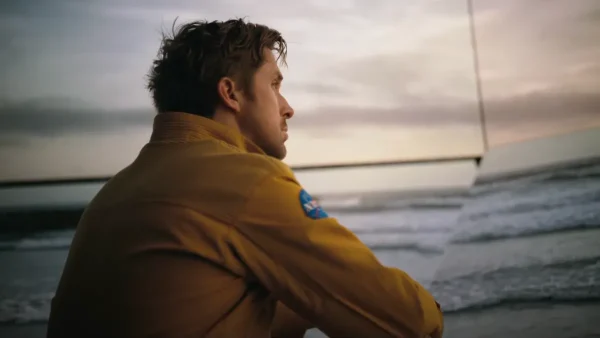
At times, the film is very emotional. Gosling’s performance is maybe his best yet, as he has great chemistry with Rocky, who is a puppet, which is impressive in and of itself. Beyond that, however, he is able to capture the desolation someone would feel being 11.9 light years away from home, but he balances his sadness with his determination to complete the mission. Supporting performances by Ortiz and Sandra Hüller as Eva Stratt, the head of Project Hail Mary, are grounded and well-done, and do well to round out the tight ensemble.
Directed by the filmmaking duo Phil Lord and Christopher Miller, “Project Hail Mary” is based on the novel of the same name by Andy Weir. Weir’s novels have a signature sense of humor, which the film maintains, and it can be a bit much. Considering the dire situation Grace and Rocky find themselves in, some of their jokes feel out of place and often serve to handicap any tension the film attempts to build. Furthermore, some of the book’s most tense sequences were cut, leaving only one really nerve-wracking scene, which largely reduces the sense of danger.
Weir does have great strengths as a writer, though, one of which is his ability to craft strong science fiction novels that rely on real science to progress their inventive plots. “Project Hail Mary” is no different, and the brilliant plot of the novel is adapted fairly accurately to the screen. However, Lord and Miller chose to prioritize emotional beats, which results in the film skipping over the scientific principles that serve as the foundation for the story’s events. The decision to add some scenes for sentimentality’s sake while brushing past some very important plot points (for example, the Taumoeba breeding) ultimately leaves parts of the film, specifically the ending, feeling very rushed.
While the script sometimes wanders into the wrong tonal territory, the visual style and appearance of the film is pitch-perfect, putting its own spin on influences from “Interstellar” and “2001: A Space Odyssey.” The production favored practical effects and puppeteering rather than modern CGI, using no green or blue screens, and the result is refreshing compared to some modern films which have an overreliance on special effects. The entirely physical sets crafted by production designer Charles Wood amazingly capture the objects and environments described in the novel, especially the alien material xenonite and the translucent tunnels Rocky creates. There are still a significant amount of visual effects in the film, though, and it uses them to great effect, with no shortage of breathtakingly beautiful shots.
Regardless of minor faults, “Project Hail Mary” is an intergalactic adventure that serves as a charming, crowd-pleasing showcase both for several remarkable actors and for the talented work of the hundreds of people responsible for the crafts of the film. Despite its length, it flies by, and makes for a gorgeous spectacle that should undoubtedly be experienced on the big screen.

