



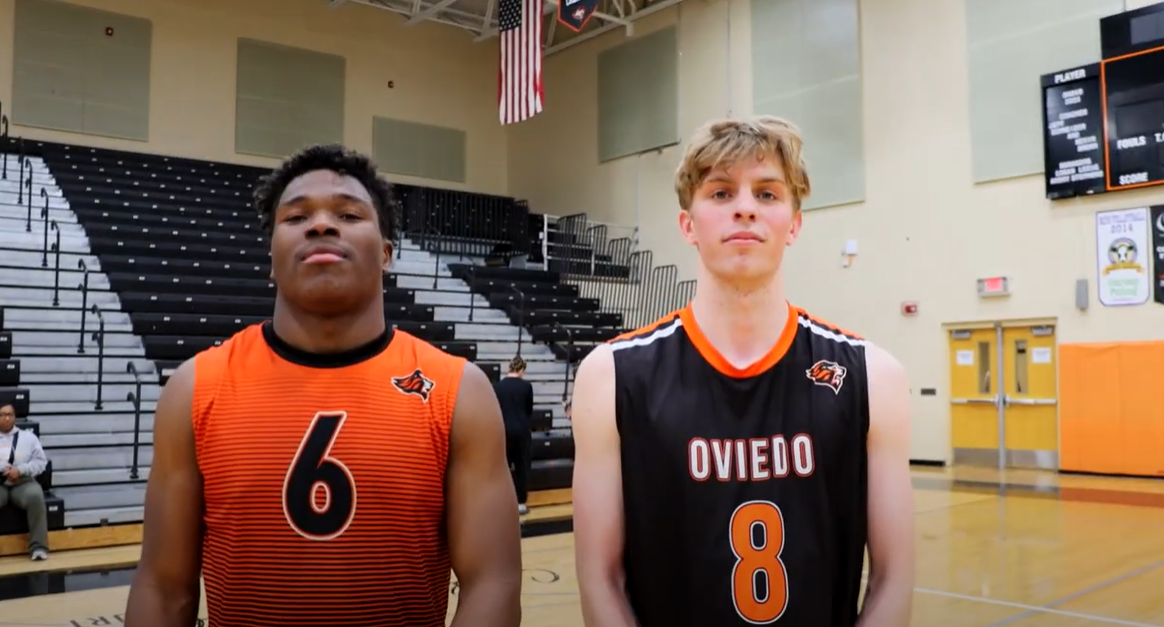



For college-bound Oviedo seniors, the third quarter marks the end of the first stage of college applications. All that’s left is to wait for results, now that the hard part of applications is out of the way. Or is it?
Making the Choice
Many seniors face another hurdle after acceptance, deferral, and/or rejection letters have arrived: deciding what college to attend. This decision could take months; its multifaceted nature means that there is no single correct decision. Elements such as tuition, academics, sports, location, Greek life, school size and potentially more may all come into play when deciding on a college, and it can often be difficult to weigh so many factors when the pressure is on. Extreme importance is placed on college in books and movies, and many students look forward to it as the best years of their life; it’s important to get it right.
“When you’re deciding what college to go to, [you should factor] in not only location and cost … but also, the student life,” senior Sofia Ascue, who is planning on attending the University of Florida (UF) for environmental engineering, said. “Because some people choose places for cost efficiency, but then they don’t actually enjoy going there, but obviously you don’t want to choose a place that’s too expensive also. So you need to find, like, a middle balance.”
College tours are often invaluable for students deciding where to attend. Tours can shed light on aspects of the college that cannot be gleaned from skimming a website or social media posts.
“I toured [the University of] Arkansas. I had never heard of it [prior to touring], and then I just fell in love with it, and … it was so pretty,” senior Grace Patton, who intends on going to the University of Arkansas for business management, said. “And I really like the Greek life and the sports and the campus … gave me such a college vibe.”
The location of a school is another heavily weighted aspect in students’ decisions. Some may favor attending a nearby school, such as Seminole State College or the University of Central Florida (UCF), while others aim for a further in-state school like UF or Florida State University (FSU), and still others aspire to go to college outside of Florida.
“Going somewhere four hours away [is challenging] … it’s not out of state, but like, it’s still a hefty drive to go there, especially when there’s so many other closer options,” senior Kendall Owen, who plans to attend FSU for marketing, said. “I’ve lived in Oviedo my whole life, so it’s kind of hard to, like, step out of it, but I’m excited to try something new.”
While options to transfer colleges exist, there is the possibility that a student’s credits don’t perfectly transfer, and students may face stress over having to “start over” at a new school, amplifying the pressure felt by students to pick the “right” school on the first try. Yet other students feel the heat of expectations (whether external or self-imposed) to go to the best school possible, even if it is not the best school for them.
“In a way, I did [feel pressure]. I know that a lot of people are shooting to go to UF, and [that] seems to be the apotheosis of where one should hope to attend that goes to our school,” senior Cooper Garvey, who wants to major in biology at UCF, said. “It feels like there is a social stigma against UCF simply as it is, or places like FSU, Seminole State, or related institutions that don’t have [as much] merit bound to their names.”
The Long Road
But of course, students do not have their pick of the litter. Students must first choose where to apply, which can be another big decision not unlike their ultimate choice. Oftentimes, students select where to apply based on similar factors to their final decision, with one key factor being academics.
“I honestly decided where to apply based on [each school’s] biochemistry program, because … certain colleges don’t have good biochemistry programs, where they incorporate both [biology and chemistry] at the same time,” senior Joshua Rasmussen, who wants to major in biochemistry, said. “UCF has a really good biochemistry program, and obviously UF has a really good biochemistry program … but a lot of other schools don’t have it. So like … FSU didn’t have my specific major.”
Teachers, family and peers can also help inform student decisions. Students may want to attend the same college as their parents or other family members, teachers might give advice and peers could share their own experiences.
“A lot of [teachers] were recommending different colleges. Like, Mr. Capp recommends FSU a lot,” Ascue said. “Some other teachers like UCF a lot, so they kind of helped show that they were good options also.”
Once seniors determine where they want to apply, they must then produce anywhere from two to ten (or more) high-quality applications in order to broaden their pool of final options. The amount of pressure placed on students during applications can detract from what many think is supposed to be the most fun year of high school.
“It was just so much at once … All of these deadlines, all of these due dates, getting my SAT fast enough, sending it in fast enough, figuring out when my materials need to be sent in, things like that, and like, my transcript needs to get in,” Rasmussen said. “All of this needs to get in. I need to get my teacher recommendations. I need my teachers to write this … All of this was just looming over me during senior year, but now that it’s over, it’s great.”
Ultimately, though, it boils down to just one more hurdle. After engaging in challenging course material for over three years and taking (and retaking) standardized tests like the SAT and ACT, college applications may simply reflect a fruitful high school career, and are a necessary final step before seniors can move on to higher education — something many of them have anticipated throughout their lives.
“I’ve always wanted to go to college … And I personally think school is, like, an amazing thing, because you can always learn,” Rasmussen said. “And honestly, learning is amazing, it’s fun to me. So like, school has always been something that I look forward to. I’m always excited to go to the next step at all times.”
Decision Recognition
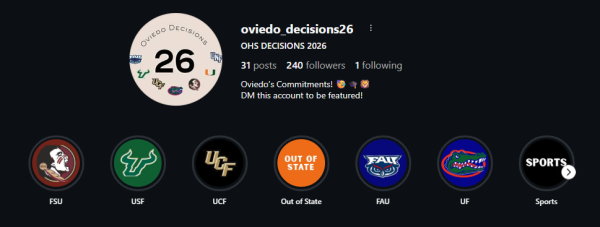
So after students have completed the entire process of applying and deciding, some may wonder: what’s next? Many seniors spend so much time on college applications that making their final decision may be anticlimactic. Enter: OHS Decisions 2026, an Instagram account dedicated to recognizing and celebrating students who have decided on a college.
The account is run by Patton and Owen, who started it in order to recognize their classmates. Students who want to be featured simply need to message the account with their name, their future college, their intended major, a current photo and a baby photo.
“Our Instagram account is made to, like, celebrate the different seniors at Oviedo … But also kind of … [to] show them off,” Owen said. “We’ve all spent 13 years going through school … and it’s like … [showing] where you’re ending up. I also think a lot of people like to see where everyone’s going.”
The pair have experience with social media, with Owen even saying it sparked her interest in marketing. Therefore, starting and running the account was a natural fit.
“I run the SGA account, and we both run the class [of 2026] Instagram,” Patton said.
So far, 30 students have been featured on the account, which has over 200 followers.
“Whether you’re going to, like a trade school or, like an in-state school or out-of-state, or like a super prestigious school. Like, I think the value is that everyone is the same, everyone’s being treated the same,” Owen said. “It’s open to everyone, and like everyone’s accomplishments are being celebrated.”
