





This story contains spoilers for “28 Years Later: The Bone Temple” and its predecessor, “28 Years Later.”
“28 Years Later: The Bone Temple” is a very violent movie, sometimes excessively so. Set in the midst of a zombie apocalypse that has ravaged Great Britain for 28 years, the film offers a no-holds barred look at the functions of life while chaos reigns. But look beyond massive Alpha zombies mutilating their victims, and you will see that “28 Years Later: The Bone Temple” offers a fascinating commentary on human nature, especially in crisis.
Last summer’s “28 Years Later” followed young boy Spike (Alfie Williams) and his lonely journey across the British mainland. The film ended on a cliffhanger, and a tonally jarring one at that: Spike is saved from a stampede of zombies by a gang of blond-haired ninjas as a rock version of the “Teletubbies” theme is played.
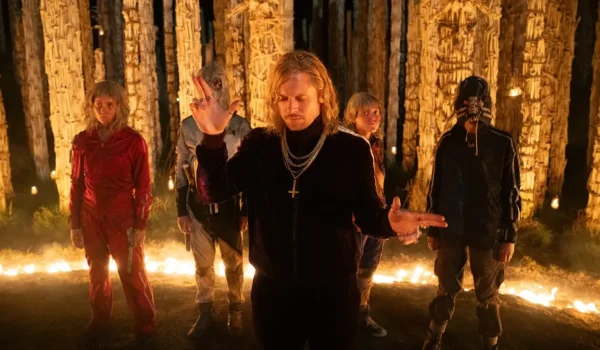
Nia DaCosta’s prompt follow-up begins with Spike having been taken in by charismatic Sir Lord Jimmy Crystal (Jack O’Connell) and his Satanic cult (whose members are also all named Jimmy, with various surnames), who saved him at the end of the prior film. But contrary to sequel convention, Spike takes an immediate backseat to Sir Jimmy, who fronts the story—only sharing substantial screentime with eccentric doctor Ian Kelson (Ralph Fiennes).
The film cuts back and forth between Sir Jimmy and Kelson, two unrelated stories set in the same world, until the two collide. As 28 years have passed since the dawn of the apocalypse, survivors have settled into their routines, and Sir Jimmy’s and Kelson’s could not be more dissimilar. Alex Garland’s impressive script uses these two bizarre characters (who would not work if not for the brilliant performances of O’Connell and Fiennes) to explore the various ways humans may cope with a crisis.
Sir Jimmy believes himself to be the son of Satan, and sees the apocalypse as divine punishment, a belief which he has spread to the Jimmys. In a religious frenzy, the Jimmys roam the land to find survivors and deliver their souls to Satan by sadistically torturing and killing them. They see the infected as mere pests; beasts to be easily and swiftly dealt with. As the Jimmys travel Great Britain, never settling down in one place for too long, they leave a trail of death in their wake. Their hateful and flippant treatment of human life is enough to make Spike—and any viewer of the film with a weak stomach—vomit. In his desperation for answers, Sir Jimmy has created a dangerous and fanatical cult, with no regard for life, no regard for nature, and no regard for morality.
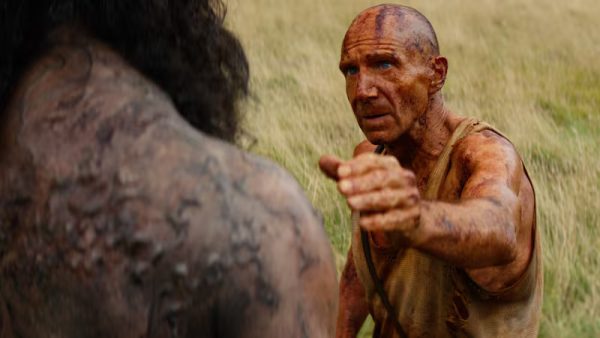
Meanwhile, Kelson spends his days maintaining his ossuary, made up of bones of the victims of the epidemic. He lives in peace, having coated his skin entirely with iodine to kill the virus that causes the outbreak, and using tranquilizer darts to repel the zombies. When he occasionally encounters the fierce Alpha zombie, who he has named Samson (Chi Lewis-Parry), he tranquilizes it and shelters in his bunker—until one day, he glimpses a shred of humanity still present in Samson. Using medicines that he has recovered from abandoned homes and hospitals, he slowly but surely treats Samson, and they form a friendship as Samson becomes increasingly lucid. Kelson has spent nearly half his life being terrorized by the zombies. This doesn’t change the fact that he is, at his core, a doctor, and the unlikely duo’s mutualistic relationship blooms as Kelson approaches the cure.
The Jimmys eventually stumble upon Kelson, and in their dogmatic mania, delude themselves into believing he is Satan. When Sir Jimmy approaches to discover the truth, Kelson meets him with curiosity, and opposing forces clash in their brief conversation. Atheism vs Satanism. Reason vs madness. Healer vs killer. By the end of it, Sir Jimmy admits to liking Kelson, even despite never liking anyone before (in his own words). The clear contrast in their ideologies is unsubtle, yes, but Garland masterfully uses this crucial scene to lay bare the film’s underpinning themes before the final scene between these two men transpires. They are mirrors of each other, polar opposites in the way they have handled this conflict, two extremes of mankind.
The film’s climax is a bloody one, as Kelson is forced to act as Satan in front of the Jimmys in order to keep up appearances, but he turns on Sir Jimmy in an attempt to aid Spike, who ultimately flees. Sir Jimmy and Kelson are both stabbed in the fight that ensues, and they lay dying next to one another. That is, until an almost-human Samson stumbles onto the scene, and in a moment of pure humanity, he tenderly relieves Kelson from his slumped position and lays him to rest elsewhere. Sir Jimmy is left alone with Samson’s wrath as both men die.
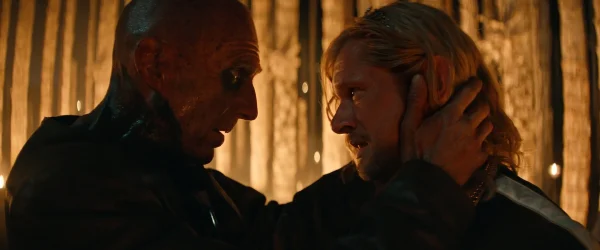
On paper, these endings are equivalent: death. But truly, they could not be more different. Both characters’ individual paths are reflected in their last moments. While Jimmy knew fear and pain, Kelson knew love and kindness—exactly what they each spent their lives spreading. Their fates underline the religious themes present in the movie as well; as the Bible says, “A man reaps what he sows.”
This conclusion makes it clear what Garland wanted the audience to take away from the movie, and while it’s not exactly a novel message, the unique way that it’s delivered makes it all the more impactful: love will triumph over hate, and kindness is the only way to continue to build a better world. Even during a brutal zombie apocalypse.





Carla • Jan 19, 2026 at 5:15 PM
Mallory I love seeing how far you’ve come in writing!